


Energy Credentials
Extensive use of passive materials in the structure has achieved high levels of energy conservation, minimising energy use in normal business use and any consequential environmental CO2 emissions.
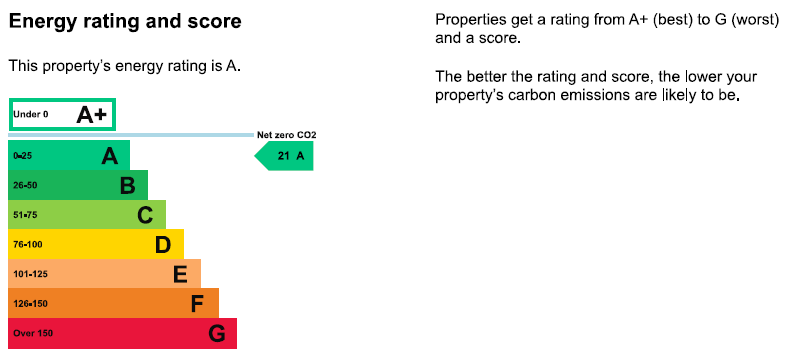
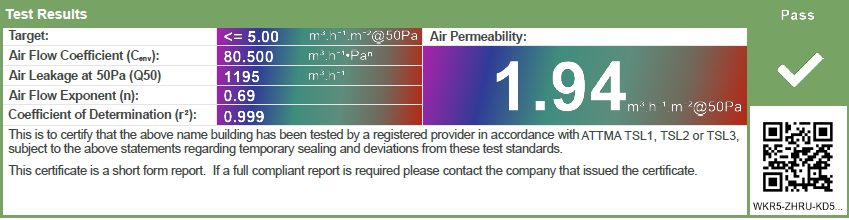
- Heat recovery ventilation recovers a minimum of 80% exhaust heat to heat incoming air
- Underfloor heating capable of heating the building at water circulation temperatures lower than 40 degC, enabling future use of alternative heat source technologies such as heat pump
- High levels of insulation achieve exceptional levels of insulation, avoiding internal over-heating in summer and even internal temperatures in the winter.
- Self-managed low energy lighting automatically adjusts each individual lighting unit operation for presence within the area and daylight level to minimise energy consumption
- Energy Rating of A(21) achieved vs a target of B(26) for a similar newly built property. This places it in the top 0.3% of ratings for buildings in North Hampshire (ONS data)
- Air Permeability Test result of 1.94 vs a target of 5.00
Site Credentials
The site has a number of existing Tree Preservation Orders (TPO) on perimeter trees. The TPO’s have been in place since 1990 and over the last 25 years, we have worked with the Hart District Tree Officer to enhance the existing TPOs by perimeter planting new Beech and Oak for next generation growth. All existing trees have been retained and protected by using a minimal impact foundation system and reinforcement of the surrounding land. This is intended to maintain the ground and established root system integrity over the entire site to both maintain healthy growth and also to ensure stability of the trees in windy conditions. The maintenance of the soil ecosystem is particularly relevant to surface root systems of Beech trees, as they have an extensive surface root system. The surface nature of the root systems results in beech trees being susceptible to stress during periods of draught. The objectives of the development plan were to:
- Preserve the existing perimeter planting
- Preserve the existing root protection areas of all trees identified within the Tree Preservation Order (TPO)
- In areas outside of the TPO, non-excavation construction methods to be adopted to minimise disturbance to existing root systems and use of permeable surfaces to maintain water and oxygen to root systems
Soil Compaction Prevention
The site areas surrounding the building will be subject to traffic by children play areas and visitors. Long term ground compaction could cause reduced oxygen and moisture limitation reaching the tree root fibre systems, reducing their effectiveness. To prevent this, commercial grade GeoCell ground reinforcement has been installed over the site. The web of cells restrains lateral movement, creating a stable, semi-rigid mat that distributes the vertical pressure over a much wider area of the sub-base. This wide distribution of force significantly reduces the pressure on any single point of the underlying soil, which in turn prevents the soil from becoming compressed. The cells have been filled with soil from elsewhere on the site to maintain the local bio ecosystem and eliminate any importation of external harmful varieties.
Structural Credentials
Minimum Impact Foundation System
The foundation system used eliminates the excavation and concrete needs of a traditional strip foundation system. Excavation for strip foundations cuts any roots and then the corrosive liquid concrete poured into the trench kills what is left of the roots. The building loads are supported by steel piles screwed into the ground, leaving the land undisturbed. The piles are screwed in using a hydraulic motor and the torque is monitored to determine when the load strata is found. The installation impact is minimal, with no excavation and soil away required. Ground compaction risk is considerably reduced over traditional foundation processes as only a small excavator operates on temporary sheeting is required within the building envelope to provide hydraulic power. The process is shown in this short video
A steel beam is then welded on to form a ring beam to support the building and this can be positioned above the current ground level to eliminate the need for excavation. The insertion of the piles is entirely reversible by unscrewing the piles by reversing the hydraulic motor. The area under the nursery building remains entirely available to future tree root activity with no risk of heave effects on the structure.
Materials Credentials
Timber construction supports a circular economy by utilizing a renewable resource that can be reused, recycled, or safely returned to the environment.
Steel in construction offers significant environmental benefits through high recyclability, reduced construction waste from prefabrication, and energy efficiency in buildings.
- Carbon Sequestration: Wood stores carbon absorbed from the atmosphere, making timber buildings carbon sinks for their lifespan, drastically reducing overall emissions compared to other materials.
- Renewable & Natural: Timber is a naturally regenerative resource, unlike finite materials, supporting sustainable forestry.
- Lower Embodied Energy: Manufacturing timber frames requires significantly less energy than producing concrete or steel, leading to lower production emissions.
- Waste Reduction: Factory prefabrication minimizes onsite waste, and timber is recyclable or biodegradable.
- Energy Efficiency: Timber frames create highly airtight, energy-efficient building envelopes, reducing operational energy consumption.
- High Recyclability: Steel is infinitely recyclable with no loss of quality, and high recovery rates (over 95%) are achieved from demolition sites, replacing primary production and saving significant energy and resources.
- Reduced Construction Waste: Prefabricated steel components minimize on-site cutting and modifications, leading to less material waste and fewer landfill contributions.
- Energy Efficiency in Buildings: Steel frames allow for better insulation, reducing energy needed for heating and cooling, thus lowering operational carbon emissions.
- Durability & Longevity: Steel structures last longer, reducing the need for replacement and associated resource consumption.
- Design for Deconstruction: Steel’s demountable nature facilitates reuse of components, promoting a circular economy.